
I. Notifications
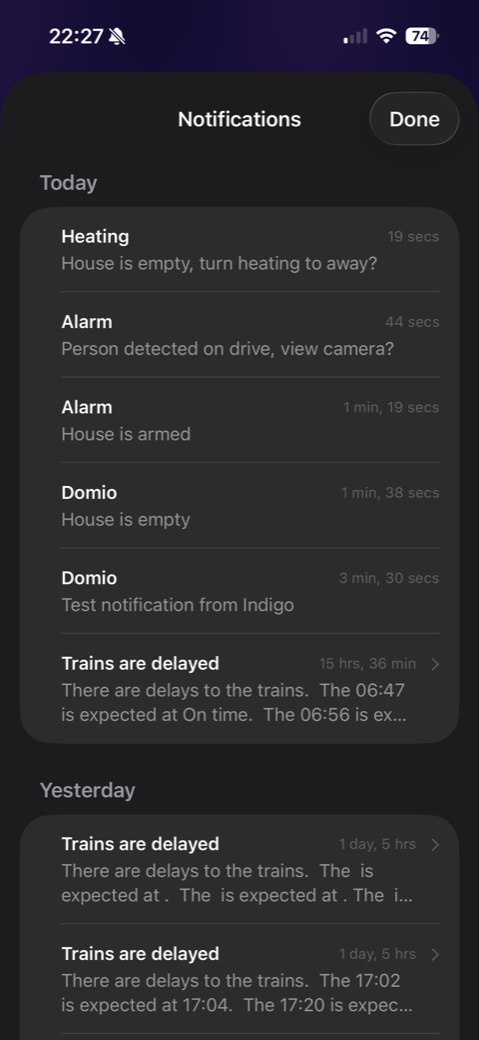
Native to iOS, native to Indigo.
Push notifications
Native alerts built for Indigo — no third-party notification services needed. Know what's happening at home, and act on it instantly.
II. Deep links
Every notification is a deep link.
Tap to jump straight to the device, open a control page, run a scene, or view the event log. No hunting through menus — the notification takes you exactly where you need to be.
| Link to | URL scheme | What happens |
|---|---|---|
| Device | domio://device/{id} |
Opens device controls — adjust, toggle, or view history |
| Control page | domio://page/{id} |
Opens your custom Indigo dashboard |
| Scene | domio://action/{id} |
Runs an action group immediately |
| Event log | domio://log |
Opens the live activity feed |
III. Per-trigger
Power where you need it.
Each Indigo trigger gets independent control — its own sound, its own message, its own destination. Critical alerts can sound different to informational ones.
Smart text
Include live values in your notifications — %%v:name%% for variables, %%d:id:state%% for device states. "Kitchen is 21.5°C" — not "Kitchen changed".
Sound & priority
Choose the sound, content, and deep link target for each trigger independently.
Widget refresh
Notifications silently update your home screen widgets, so device status stays current.
Notification history
Missed something? View past alerts in the app with timestamps and deep links to the source.
IV. Setup
Up and running in minutes.
If you can already build an Indigo trigger, you already know how to use dom.io Push.
Install
Install the dom.io Push plugin on your Indigo server.
Configure
Create triggers in Indigo for any device, variable, or event you want to know about.
Done
Instant alerts on every family device — with deep links straight to the action.
V. Turn on later
Said not now? Switch them on any time.
If you declined notifications when dom.io first asked, you can turn them on whenever you like. iOS only ever shows that permission prompt once, so it's done from the iOS Settings app — then dom.io registers your device automatically the next time it connects.
Allow notifications
Open the iOS Settings app and scroll to Domio — or go to Settings → Notifications → Domio. Turn on Allow Notifications, then choose how alerts appear: lock screen, banners, sounds, and badges.
Allow background refresh
So your widgets stay current, check that Settings → General → Background App Refresh is on, with Domio enabled in the list. Recommended, not required.
Reopen dom.io
Launch dom.io and let it connect to your Indigo server. It registers your device for push and tells Indigo where to send alerts — nothing else to do.
To confirm it worked, open Settings → Notifications in dom.io: you should see Push Notifications: Enabled, Relay: Online, and Device Registered. The "notifications are disabled" banner on the Home tab disappears once it's done — and tapping Open Settings on that banner is the quickest route to the right screen.
VI. Privacy
Private by design.
Notifications are relayed through a stateless Cloudflare Worker. The Worker authenticates your device, forwards the notification to Apple, and immediately discards the content. There is no server, no database of notifications, and no way to read your messages after delivery.